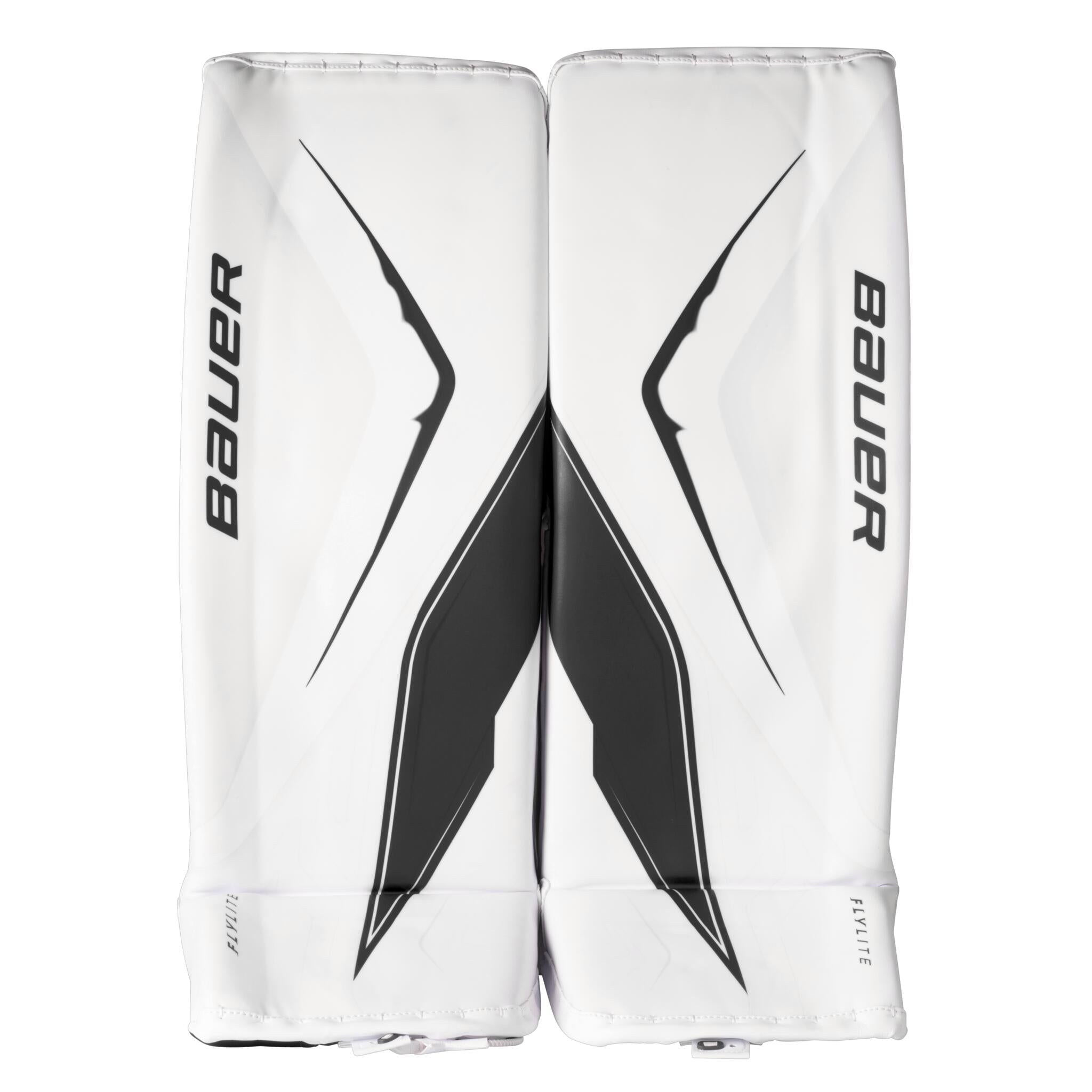
08 / Why a pad exists
A leg pad is not just something you wear. It is something you move.
The pad must stop a puck, survive impact, move over ice, remain attached to the leg without controlling the leg, and be ready for the next save. Those jobs compete. Every design is a compromise between them.
A blocker, a slider and a suspension system
Look at a modern goalie in the butterfly. The pad face is presented toward the puck. The knee is supported by a landing block. The inside edge contacts the ice. The skate may be lifted, extended or angled to find an edge. The toe connection limits how far the pad and skate can separate. The calf wrap determines how freely the pad can rotate around the shin. The thigh rise occupies space between the legs. All of those parts are simultaneously doing work. Changing one can change the way the others behave.
This is why a pad that feels wonderful standing in a store can disappoint on the ice. Standing comfort tells you very little about how a pad seals when the knee descends, how its bottom edge clears the skate, or whether the thigh rises collide during a rapid recovery. There is no meaningful assessment without the equipment moving in the positions for which it was designed.
Coverage is geometry, not just square inches
A wider or longer pad may appear to cover more net. But the face only protects space when the goalie can place it there. A tall thigh rise that blocks the legs from closing, or a pad that rotates late and leaves an opening, can undermine the coverage its dimensions were meant to provide. The goal is usable coverage: a seal that the goalie can repeat without having to force the legs into an uncomfortable position.
We should distinguish the pad's projected area when facing a shooter from the actual sealing surfaces touching the ice. They are related, but not the same. A pad can look enormous in photographs and still leave an inconsistent butterfly seal if its knee location, boot geometry or rotation is wrong.
Rebound distance is not automatically rebound quality
A firm, springy face may send a puck farther than a soft construction when struck under similar conditions. Farther is not always better. A hard rebound into the corner can be excellent, but a hard rebound into the slot is still dangerous. Likewise, a pad that absorbs more energy can give a goalie a manageable puck, or it can leave the puck nearby in a place the goalie cannot easily cover. Rebound behavior is a partnership between construction, impact location, pad angle, body control and where the goalie intends the puck to go.
A legitimate comparison would use the same puck type, shot velocity, impact location, pad orientation and ice conditions, measuring exit speed and direction. No one should publish a ranking of rebound performance based on a few hand-tossed pucks or manufacturers' adjectives.
The second save is the forgotten test
Parents often watch a goalie drop, see a large butterfly seal, and call the equipment good. The more revealing question is what happens afterward. Can the goalie immediately find the skate edge? Does the knee remain centered on its block? Can the pad return with the leg or must the goalie kick it back into place? Does the upper pad obstruct a cross-crease recovery? A construction that looks powerful on the first save may be counterproductive if it makes the next save slow, awkward or inconsistent.
Throughout this guide, a claimed advantage only matters when we explain which movement it is supposed to improve, what compromise it might create, and how a goalie can test the result.
09 / The flex atlas
Stop asking whether a pad is soft. Ask where, when and in which direction it bends.
A stiffness description without a location, loading direction or test method is not enough to compare two leg pads.
The three longitudinal zones
Boot: The lower section must interface with the skate as the ankle moves. A softer boot can provide independent movement; a more structured boot can change how directly the pad follows the leg. Its angle and channel depth matter as much as the material. Shin and knee: This zone influences how readily the pad changes shape around the lower leg and how stable the landing feels. Thigh rise: This is the upper structure that shapes five-hole coverage and must retain enough geometry to meet the opposite pad, yet avoid binding when the goalie moves.
A pad can have a soft boot and a stiff thigh, or an accommodating shin and a reinforced thigh face. Neither is inherently contradictory. The design is deliberately separating movement zones from blocking zones. Brian's published Regular, Cross and Stiff ICONIK 2 profiles are an unusually clear example of how multiple flex behaviors can exist inside one family.
Longitudinal bending is not torsional twisting
Try to bend a pad forward and backward along its length: that tests one kind of stiffness. Now twist the top relative to the boot: that tests a different kind. Put the face under localized pressure: that tests yet another response. People routinely use the same word—stiff—for all three. Those differences are important because an upper pad that holds its shape during a butterfly might still rotate easily around the leg, while a pad that bends longitudinally might resist unwanted twist through the knee region.
It is also important to separate designed curvature from actual flexibility. A pre-curved pad can look as though it has already bent. That does not prove it will be easy to bend further. Conversely, a visually straight pad can flex at an engineered break. The photograph does not tell the whole story.
Breaks: appearance, structure and marketing
Single-break, double-break and no-break descriptions are common, but an exterior crease or decorative knee roll does not prove the internal core shares that exact break location. Some pads maintain a flat face while using internal flex architecture; other pads display traditional rolls while using modern reinforcements. We must show front, side and rear evidence and identify exactly whether a break is a surface feature, a core feature, or both.
The most responsible pad comparison doesn't score all designs on one fictional one-to-ten stiffness scale. It records the published design, then evaluates actual bending under controlled and repeatable loading if samples are available. Without that data, we can explain likely movement consequences but should not invent measured rankings.
Who benefits from which response?
Some goalies want the upper pad to stay straight and predictable as they settle into a blocking butterfly. Others are more comfortable when the pad accommodates unusual leg positions or frequent reactive movements. A flexible boot may assist a goalie who aggressively seeks skate-edge access; another goalie may prefer a more direct lower-pad response. These are tendencies worth testing, not a rule that standing or hybrid goalies must buy soft pads or butterfly goalies must buy rigid pads.
Technique matters, but it never overrides anatomy. A pad that produces an impressive seal yet forces the goalie into pain, unstable landings or repeated knee misses is not a correct match regardless of performance claims.
10 / Material science without the marketing fog
What are you actually paying for inside the pad?
Cover materials, energy-absorbing foams, structural reinforcement, adhesives, edge materials and workmanship all affect a pad. Product brochures rarely reveal the entire internal stack.
Surface is not core
The outside of a pad is asked to resist abrasion, tolerate cold and moisture, and present a durable surface for repeated puck strikes. Under it sits a structure that can include foams with different behavior, supportive panels and reinforcement. The materials that make a face durable may not be the same ones that make the upper leg stiff or the knee landing comfortable. When a manufacturer advertises one material, we should identify whether it is in the face, core, thigh, sliding edge or only a limited part of the product.
Foam terminology deserves the same care. Words such as high density, supercritical, rebound and composite refer to different material properties or manufacturing choices. They do not automatically mean superior protection, lower mass and faster rebounds simultaneously. If a pad claims an improved energy response, we need to ask how that claim was established and whether the comparison involves the same pad size and setup.
How construction influences rebounds
When a puck strikes the pad, it deforms the contact surface and underlying structure. Some of that energy is temporarily stored and returned, some is dissipated, and some changes the puck's direction. The player's pad angle and movement can dominate the direction of the rebound. Two products using different core constructions may therefore feel different on identical shots, but only controlled testing could tell us how much of that difference belongs to the materials.
We should diagram a puck entering, compressing and leaving the pad, clearly marking where energy is stored and dissipated. That figure must be a physics model with stated assumptions, not a fake manufacturer cutaway.
The knee block may be the most consequential hidden assembly
Manufacturers describe knee blocks using terms such as integrated, reinforced, stabilizing or removable. These words are not interchangeable. A landing platform can vary in thickness, internal cushioning, attachment to the core, side support and how it moves under load. A stable platform can feel very different from one that shifts when a goalie drives laterally, even if both pads appear similar from the front.
The knee block is also where sizing mistakes become tangible. If the knee lands at its edge, strapping may disguise the problem during a standing fitting without fixing the fundamental position. We need standardized close-up photos of every pad's rear knee assembly, ideally photographed with the same ruler placement and camera angle.
Why the toe, boot and sliding edge are different engineering problems
The boot manages contact with the skate; the toe bridge connects to it; the inner edge interfaces with the ice. Changing the sliding material might reduce friction under some conditions without improving pad rotation. Altering the toe tie might increase ankle freedom without changing the knee block at all. A more tapered toe can alter boot clearance without meaningfully changing the upper-thigh construction. The guide should not collapse all of these details under a vague claim that a pad is “more mobile.”
Real cutaways versus conceptual diagrams
There is no shortcut here: to show the actual internal layering of a 2025–2026 flagship, we need a verified manufacturer cross-section, a genuine factory image showing assembly, or a physically opened example of that model. An older teardown or patent can show design principles but cannot prove the materials or dimensions of a later release. Every internal diagram in the final guide must be labeled confirmed construction, manufacturer illustration, or conceptual mechanical schematic. No imaginary colored foam sandwiches presented as fact.
11 / The six-brand engineering conversation
Six manufacturers. Different answers to the same mechanical problem.
These are design comparisons, not rankings. Model year, generation and individual build configuration matter more than blanket claims about a brand.
Vaughn — tradition in appearance does not mean tradition under the cover
Vaughn is an especially important manufacturer for explaining why graphics and exterior knee rolls can mislead. Its Velocity and Ventus-derived families may present distinctly different outward personalities, yet both belong in a discussion of modern foam, reinforcement and rotation systems. Compare the VX1's shaped, traditionally influenced architecture with the SLR4's more structured blocking direction and the ION family's changes at the face and knee assembly. A prospective owner must compare the actual internal options and boot behavior of the version in front of them, not assume all Vaughn pads are “soft.”
The correct question is whether the pad permits the athlete to maintain their preferred seal and recover immediately. The question isn't whether a photographer can make the rolls look classic.
Brian's — the clearest demonstration that stiffness belongs to a zone
Brian's offers one of our most useful teaching cases. In the ICONIK 2 line, the Regular, Cross and Stiff configurations vary knee and thigh firmness while retaining a softer boot philosophy. OPTIK 4 uses its own distinctive profile options. That lets us show the reader that even within one manufacturer and one pad family, “the pad is stiff” may not be a complete statement. We need compare available core options, knee landings, toe taper, sliding materials and calf-wrap design before claiming that an ICONIK and OPTIK are appropriate for the same goalie.
Brian's also makes the measurement discussion unavoidable: its published fit references emphasize ankle-to-knee and upper-leg measurements. That cannot be directly converted into another brand's FTK chart by inventing one magic offset.
Bauer — look beyond Vapor versus Supreme labels
For the 2025–2026 period, Vapor FlyLite and Supreme Fuse illustrate two identifiable construction stories. Bauer describes FlyLite with defined flex points around the knee and reinforced upper structure; Fuse emphasizes a different mid-flex approach and stabilizing knee architecture. We should show exactly what Bauer confirms about its core, boot and knee system, then compare how those features might influence a goalie who moves aggressively from their knees versus one who prioritizes blocking consistency.
Never simply tell readers one Bauer line is for quick goalies and the other for powerful goalies. Those labels may capture part of the intended product story, but they cannot replace fit, actual knee placement, or the goalie's response to the equipment.
TRUE — keep the flagship and second-price-point comparison honest
TRUE's Catalyst, HZRDUS and 2026 Nitro families provide different examples of core structure, boot behavior and leg-retention geometry. The Nitro discussion is especially valuable because higher-end design ideas appear in both premium and more accessible builds. We should itemize exactly which foam, reinforcement, knee and strapping features are shared and which are changed, then compare pad mass and construction only where reliable figures exist.
A price gap by itself tells us nothing about how much quicker the cheaper pad will wear out or how much better the expensive one will play. Those outcomes require real testing. The guide's job is to show where the actual construction changes, not manufacture a performance percentage.
Warrior — modularity, sliding systems and 2026 Alpha Surge
Warrior belongs alongside every other brand, not in a footnote. The Ritual G7 family remains relevant to the 2025 retail market, while the 2026 Alpha Surge, S50 and junior S30 need their own discussion. The adjustable features of Alpha Surge, the different core architecture of S50, and Warrior's removable SlidePlate system make the family a useful case study in how mechanical feel can be influenced by modular construction.
We must distinguish which design belongs to which year; for example, a useful feature described on G7 does not automatically exist in the same form on Alpha Surge. And we must be precise about whether a component is standard, optional or specific to a custom build.
CCM — EFLEX and Tacks are two construction philosophies, not two levels of quality
CCM's 2025 EFLEX 7 emphasizes a different lower-leg flex response from the 2026 Tacks Pro's shaped V-Core blocking approach. The knee system, boot and pad-face response deserve their own comparison, while the EFLEX 7.9 and 7.5 illustrate what changes across price tiers. The goal isn't to declare the newer one superior. It is to show why an athlete might prefer one geometry even if both pads are correctly sized.
Every manufacturer receives the same comparison template: intended design, proven features, model-specific fit, user-experienced trade-offs, lower-tier alternative, historical context and linked original source. No manufacturer receives a bigger section because its marketing material is easier to find.
12 / Geometry and actual fit
The number on the pad does not tell you where your knee will land.
A 32-inch label is not the same thing as a 32-inch measurement of your own shin. A +2 thigh rise is not a solution for a misaligned knee. Even two adjacent generations from the same brand can fit differently.
ATK and FTK are measurements of different things
ATK means ankle to knee. Manufacturer instructions typically define a particular ankle-bone landmark and the center of the knee; the measurement travels between those prescribed anatomical points. FTK means floor to knee. It ordinarily describes the vertical height between the floor and the kneecap landmark in a specified barefoot measuring posture. The ankle bone is above the floor and may move relative to it as posture changes. Consequently, ATK does not become FTK merely by adding an arbitrary inch or two.
In the 2025–2026 market, Bauer's sizing guide uses FTK, which it refers to as shin height. Brian's uses an ATK-based chart together with a knee-to-thigh reference. CCM's current retail fit information uses FTK; TRUE's available retail size charts generally use a knee-to-floor reference, while model specifications must be checked. Vaughn's public charts and retailer guidance can vary by model, so we should explicitly identify the VX1, SLR4 or ION source used rather than publish a universal conversion. These differences are not trivia. They are the reason a reader must identify the exact model before using a chart.
The knee block is the actual proof
The factory size chart is the starting point. The goalie's knee should arrive in the intended landing region while wearing the actual knee guard, skate and strapping configuration. A pad that sits too tall can place the knee below its intended landing point; a pad that is too short can place it above. The precise location depends on the rear construction and how the pad settles on the skate. A goalie must drop into butterfly repeatedly, recover, move laterally and check whether the knee remains consistently supported.
The fitter should observe the landing, not simply ask whether the pad feels comfortable. Young goalies in particular may tolerate an awkward position without explaining it. A pad that requires a child to pull straps excessively tight to keep the knee inside its landing platform deserves suspicion.
Thigh rise and base size solve different problems
The number before the plus is associated with the primary pad sizing convention for that family. The plus designation generally refers to additional thigh rise relative to a maker's base geometry. That does not mean the upper extension of every 32+2 from every brand is the same real-world height, nor that a taller thigh rise moves the knee block to the proper location. A reader comparing brands needs to evaluate the actual top-of-pad position when the knee is centered.
In butterfly, the upper pads should meet in a repeatable way without binding the legs or forcing an uncomfortable hip position. During recovery, their tips should clear one another. Too much thigh rise can create a collision problem; too little can expose an unwanted opening. Either problem can also be influenced by technique and knee spacing, which is why no article should recommend a universal +1 or +2 based only on age.
Fit can change when you change skates
Pad position does not exist independently of the skate. Different boot shapes, skate heights and blade holders change how the pad's boot rests and what the ankle can do. Changing skate size during a growth spurt may shift pad behavior even before the pads are replaced. A toe tie routed differently can also pull the lower pad into a new starting position. Before concluding that pads have suddenly become too short, check the entire skate-to-pad interface.
Fitment is also a moving test
Have the goalie stand, shuffle, drop, recover to both legs, butterfly slide both directions and move in and out of RVH on each post. Ask whether one side consistently feels different. Observe whether the pad rotates into position and returns with the athlete, whether the knee stays supported, and whether the boot clears the skate. An adequate fit should remain functional through those movements, not only while the goalie is standing still.
13 / What happens during a save
The pad should support your movement. It should not dictate it.
The right pad is not defined by one ideal butterfly photograph. It is defined by repeatable movement from one save into the next.
The standing stance
In a ready stance, the pads are arranged along the legs and need to move without catching against one another. The athlete should be able to shuffle, turn and recover their balance naturally. If the calf wrap restricts ankle motion, if the thigh rise constantly collides with its partner, or if an oversized pad changes stride, the equipment has already introduced a compromise before the first shot.
The butterfly landing
During a butterfly, the upper leg and lower leg rotate into a position that permits the pads to face forward. The knee contacts its landing surface, the inside edge moves against the ice, and the skate needs sufficient freedom to follow the leg's position. A pad that resists rotation may leave the face pointing in the wrong direction. A pad that rotates excessively can feel unstable or require extra movement to recover. Neither issue is determined by core stiffness alone: strapping, toe ties and the fit of the knee and boot all matter.
Hip mobility varies greatly. Forcing a player to achieve a wide butterfly by manipulating straps or using equipment that effectively pulls the skate into position is not a sound fitting strategy. A published study found that pad configuration changed butterfly width under test conditions without significantly changing peak hip internal rotation. That is exactly why claims that a particular strap or pad “saves the hips” require more evidence.
Sliding and recovering
When sliding across the crease, the goalie uses the skate edge and body mechanics to generate movement while the pad's inner material travels across ice. Surface finish, knee-block design, athlete weight, ice condition and worn material all influence the feel. A glossy inner edge is not proof of low friction under every loading condition. We should test sliding on comparable ice, with a consistent load, rather than accept manufacturer adjectives as measured performance.
The recovery is an equally important test: can the athlete find the pushing skate edge, get the pad clear of the ice, and return to standing without the thigh rise trapping the other pad? If the goalie needs to adjust pads by hand after every drill, something about the construction, fit or strapping may be working against them.
RVH and the post
Reverse vertical-horizontal brings the goalie into a difficult interaction between pad, skate and goalpost. The toe bridge may be used to help seal the post, while the goalie maintains enough ankle and skate mobility to push away. A strap system that holds the pad in one precise position may feel secure during the initial seal but may also introduce resistance during the transition out of it. The correct amount of slack and elastic return needs to be evaluated during the exact post technique the player uses.
Some goalies prefer traditional lace ties because once the initial slack is taken up, the connection has little additional stretch. That can make the relative position of the toe bridge feel predictable during a post push. Others prefer an elastic system for its restoring action and simpler dressing. Both deserve a proper test rather than a categorical winner.
Rebound control and second saves
A stiff pad can send the puck outward with more energy; a softer face may absorb more. But a great rebound is one that lands somewhere the goalie and defenders can manage. We should illustrate impacts at the ankle, middle shin, knee region and upper thigh, because the point of contact changes where force is applied and how the face is oriented. The next movement—cover, reposition, or react to a second shot—must be part of judging whether the pad is effective.
14 / Strapping and toe connections
Straps should keep the pad with you without turning it into a splint.
Modern goalie pads are generally designed to rotate around the leg in the butterfly. Secure retention and free rotation are not opposites; they are the two tasks the strap system must balance.
What changed from leather straps?
Traditional pads often relied on multiple leather straps along the leg, each tightened independently. Modern systems frequently use wide elastic calf wraps, hook-and-loop connections, knee-to-calf routing and more strategically placed attachment points. Fewer attachment points can simplify dressing while allowing controlled movement. Yet a broad strap can still be over-tightened, and an easy-to-adjust system can still fit incorrectly. The number of straps is not itself a quality rating.
Calf wrap, knee strap and professor-style support are different controls
The calf wrap influences how the pad follows the lower leg and returns after rotation. A knee strap may secure the landing region directly to the knee cradle or run down toward the calf, changing the space available for rotation. Professor-style straps or auxiliary calf connections, where provided, can alter the relative placement of the lower leg inside the pad. These details influence behavior only in combination with the pad's rear geometry. We should illustrate each route using a rear photograph of the actual model—not a generic invented strap layout.
The fitting question is not “How tight can I get it?” It is “What is the minimum tension that keeps the knee and pad where they need to be through repeated saves?” Excessive tension can reduce rotational freedom. Too little retention can create unpredictable positioning. Both extremes deserve adjustment before someone concludes that the core itself is wrong.
Traditional skate laces with deliberately set slack
A skate lace is relatively inelastic compared with an elastic toe tie. If the knot provides a gap, the skate can travel through that gap before the tie becomes taut. Once taut, further separation is limited primarily by small material stretch, knot movement and routing. This mechanical pattern appeals to players who want a defined endpoint when the skate and pad separate, especially around the post. But not every goalie needs the same amount of slack, and loose lace routing can introduce new problems if the connection catches or does not let the pad return appropriately.
To fit laces, document where the skate is while standing, during butterfly, and in RVH. Make small changes to the gap and repeat each movement. Never assume that two inches of lace slack measured one way produces the same effect on every pad and skate.
Bungee systems and the constant-tension question
Elastic ties stretch under load and provide a restoring force. Depending on pretension and routing, the cord can exert some pull even before the skate reaches a large separation. That return force can help some pads settle into their intended orientation. The same force may feel restrictive or may change post connection under load for another goalie. There is no universal bungee behavior because cord elasticity, original length, mounting position and tension differ across products and setups.
Our interactive diagram shows this mechanical distinction with an illustrative force-displacement curve, not manufacturer-measured data. To quantify a real setup we would need to measure extension force in a fixture and correlate it with actual on-ice motion.
Hybrids, offset systems and boot straps
A hybrid connection combines relatively static and elastic sections, potentially giving the pad one kind of response early in its movement and another after additional travel. CCM's EFLEX 7 hybrid setup provides a timely reference, but the construction must be described precisely for that model. The boot strap, if present, performs yet another job: setting how the pad rests and is retained at the lower leg. Removing, loosening or relocating it can change fit, but that is not an argument for always removing it.
What to watch in a toe-tie comparison
Use the same pads, same skates and same goalie for a sequence of tests with lace, bungee and hybrid configurations where safely compatible. Record how the pad rotates, whether the knee lands correctly, whether the goalie can find the edge, whether the toe bridge holds its position at the post and whether recoveries remain consistent. Comfort matters, especially over a full practice, but a single enthusiastic test is not enough to make broad medical claims.
15 / What the price really buys
A professional pad and a less expensive pad can look nearly identical. They are not necessarily built the same.
But “not identical” is not the same thing as “inadequate.” The question is which differences matter for the athlete's workload and movement.
Why flagship models cost more
A flagship product may use more expensive core reinforcement, specialized face and sliding materials, more elaborate knee assemblies, greater customization, higher-cost manufacturing processes or different quality-control requirements. Custom production and domestic labor can affect cost independently of the pad's on-ice feel. None of those differences is meaningless, but we should resist assuming each creates a performance improvement for every player.
At the lower price points, manufacturers may simplify internal reinforcement, choose a different construction method, use fewer customization options or substitute materials. Some still retain important features from the premium family. Our comparison must identify the exact changes on the real product pages and, where possible, through physical examination. Do not imply a second-price-point pad is just a pro pad with cheaper graphics—or a dangerous imitation of it.
Elite, Pro, intermediate and youth are product categories, not a moral hierarchy
A young goalie needs properly scaled equipment and sufficient protection for their level of play, not the heaviest or stiffest flagship sold to adults. As athletes grow and face more frequent shots, the workload, fit precision and durability requirements change. But a talented child might still be better served by a carefully designed junior pad than by an oversized intermediate pad purchased for status. An adult recreational goalie may happily use expensive equipment if the fit and movement are right. Competition level informs the decision without dictating it.
Age does not determine your butterfly
One of the greatest mistakes in equipment conversations is to treat age as a direct proxy for leg strength, hip mobility and technical skill. A seven-year-old who plays multiple competitive games a week and a seven-year-old taking a first goalie lesson may have very different skill requirements. Neither should be forced to fit into a model that places the knee outside the landing zone. Growth introduces another problem: buying “one size up” can compromise today’s protection and movement to avoid a future purchase.
Families should repeat the knee-landing test after growth spurts, skate changes and major strap adjustments. If a goalie suddenly finds recovery difficult, check fit before concluding that a new or more expensive pad is necessary.
The aesthetic trap and the expensive-equipment trap
There is nothing wrong with loving a pad's graphic. Equipment identity matters to athletes. But the graphic does not determine the location of the knee landing, the flex of the boot or the response of the toe connection. Ask a parent what the pad is built to do before asking whether the colors match the jersey. If the answer is only a brand, a famous goalie or a price, the shopping process is not finished.
The same principle applies to social media. An NHL goalie’s equipment may be heavily customized and sometimes differs materially from the retail version that carries similar artwork. Professional endorsement and visibility are not evidence that the pad will suit a particular child's anatomy or style.
Can last year's pro pad beat this year's cheaper model?
It can be a reasonable value, but only if the used or older pad still fits and its protective structure is intact. Check compressed knee blocks, deformed thigh rises, damaged bindings, inner-edge wear, detached straps and persistent twisting. Cosmetic puck marks do not necessarily indicate structural failure; an apparently clean exterior does not rule it out. We should show real examples of repairable cosmetic damage versus failure of core support that warrants replacement.
16 / The pad has to earn the purchase
Make the pad prove itself before you pay for it.
No brand should win because the goalie walked in wanting it. Every contender should pass the same evidence-based sequence.
Before entering the store
Measure ATK and FTK using the intended manufacturer's landmarks, record the current skate size and knee-guard model, and identify which pad family is under consideration. Bring the goalie’s protective gear when possible. Write down the existing problems before seeing any new graphics: “my knees land high,” “the toe tie drags at the post,” “my calf wrap catches,” or “I struggle to recover on my left side.” Otherwise, a new pad may feel exciting simply because it is new.
The standing and butterfly sequence
Start with a neutral standing stance, walk and shuffle, then drop several times. Look at the knee landing from behind, not only at the view from the front. Is it centered? Does it move between repetitions? Is the pad rolling into its intended playing face? Does the athlete have to force the position? Recover to both sides. A candidate that fits only when a salesperson holds it in place has not passed.
The movement sequence
Where a shop permits it, simulate edge access and recoveries safely. On the ice, add lateral slides, post integrations and RVH exits. Check for thigh-rise collisions, pad rotation lag, leg-binding sensations, boot interference and toe-connection behavior. Do not let the player “win” the trial by using one dramatic save pose. What matters is whether ordinary movements can be repeated without extra adjustments.
The blind comparison
Have the goalie try two correctly sized models without being told which is more expensive if practical. Ask which feels easier to move in, which knee landing feels stable, which boot feels free, and which produces a natural recovery. An eight-year-old may not use the language “torsional stiffness”; they can still identify whether one pad feels like it follows the leg and another feels as though it is being dragged.
Only after that should price, color and manufacturer enter the decision. The label is useful for keeping track of the result, not for determining the result.
What a coach or parent should write down
Record the pad's brand, precise model, year, size and thigh-rise designation. Then note ATK, FTK, knee position, amount of toe-tie slack, boot strap choice, calf strap route, perceived ankle freedom, pad return, five-hole seal and recovery consistency. If a test fails, record what adjustment was attempted. This makes the next fitting far more informed and protects against repeating the same expensive mistake.
Five claims we should stop repeating
“Stiffer is better for serious goalies.” Only if that response matches the player's actual movement. “Soft means poor rebounds.” Rebound direction and energy depend on more than overall stiffness. “The highest model is the safest.” Protection requires correct sizing, condition and appropriate construction; price alone is not a safety rating. “A +2 will fix a short pad.” Thigh rise does not move the knee block. “A pro wears it, so it must be right.” Professional equipment and individual bodies are not universal fit templates.
There is no best pad—only a justified match
The goal of this guide is not to talk anyone out of buying excellent equipment. It's to make sure the buyer understands what excellence means for their own body and game. The best result is a goalie who can explain why the pad's flex, fit and connection support their technique, who knows what compromise they accepted, and who could make the same choice again without needing the graphic or the price tag to make it for them.
17 / Interactive equipment troubleshooting
What does the goalie actually experience?
Select an observable problem. This isn't a medical diagnosis or a universal prescription; it's a methodical starting point for inspection.
Check model, size, guard and skate compatibility before making significant strap changes. Stop if the goalie experiences pain.