

HOCKEY DETOXFIELD GUIDES / NO. 002

THE
SCIENCEbeneathTHE STEEL.

A complete visual guide to the steel beneath every hockey skate. From your child’s first strides to competitive forwards, defensemen, adult players and goaltenders, understand what profiling changes—and what it doesn’t.
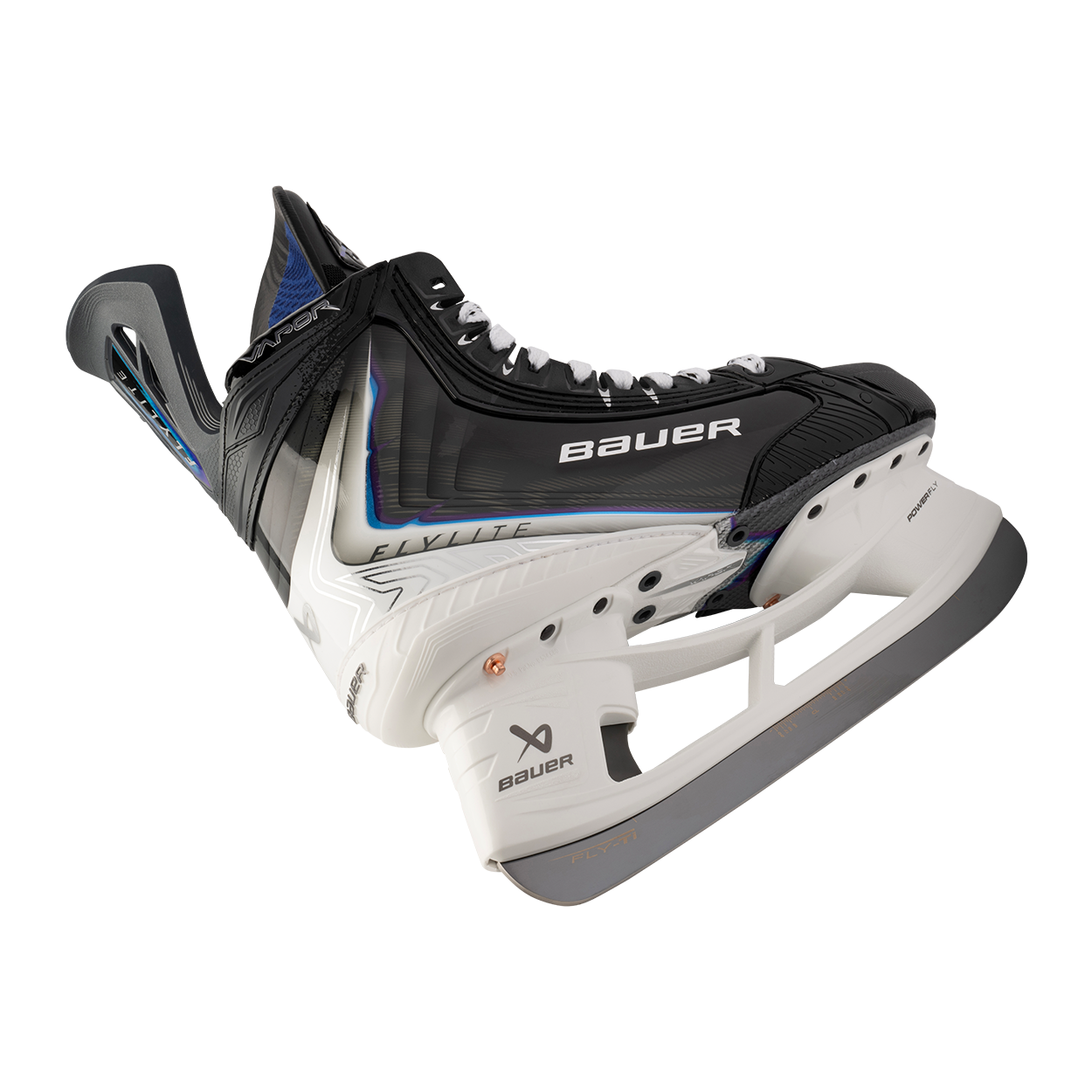
THE SHAPE IS THE STORY.
Authentic Bauer Vapor FLYLITE player skate with white POWERFLY holder and steel runner
FOR THE ENTIRE HOCKEY COMMUNITYEVERY SKATER.
EVERY LEVEL.
YOUTH & DEVELOPING PLAYERSFORWARDS & DEFENSEMENADULT & RECREATIONAL HOCKEYGOALTENDERS

YOU DON'T NEED
A BETTER NUMBER.
YOU NEED A
BETTER ANSWER.

Two skaters can wear the same boots, skate on the same steel, and feel entirely different underfoot. The difference might be the shape of the blade. Or it might be sharpening, fit, technique, or an uneven edge.

Before spending money on a new profile, learn exactly which variable you're changing.

01

THE BOOT

Fit, heel lock, support and ankle movement determine how your body communicates with the skate.

02

THE ROCKER

Front-to-back geometry, usually described with radii measured in feet.

03

THE EDGES

The sharpening hollow and edge finish, measured on a completely different axis.

9 FEET.
13 FEET.
WHAT CHANGES?

The profile number is the radius of an imaginary circle—not blade length. A shorter radius is more curved. A longer radius is flatter. The effect is real, but the differences across a short runner are smaller than many marketing graphics suggest.

FIGURE 001 / LONGITUDINAL PROFILE280 MM REFERENCE CHORD
280 mm working blade length, conceptualHEELTOESELECTED RADIUS10 ft reference (dashed)

ADJUST YOUR ROCKER

9'
CALCULATED CENTER-TO-END RISE3.58 MM

A shorter radius may produce a more responsive rocking sensation, at the expense of a planted feel for some skaters.

Mathematically calculated circular arcs. The curves share a 280 mm chord and a common center point. Vertical displacement enlarged approximately 7× relative to horizontal for legibility. This is an educational comparison, not a commercial profiling template.

ONE PIECE
OF STEEL.
FOUR SYSTEMS.

Single, dual, triple and Quad profiles distribute curvature differently. These are ways of constructing a continuous curve—not a ranking from basic to advanced. Select a family to see an illustrative shape and understand the tradeoffs.

ENGINEERING STUDY / CONTOUR 002
HEELTOE10' CONTINUOUS RADIUS
Blended, continuous-tangent diagrams. Vertical magnification is illustrative, and this is not a machine template.
SINGLE-RADIUS CONTOUR

THE SIMPLE
BASELINE.

One circular radius along the working blade. Straightforward to understand, inspect and reproduce. Many competitive skaters have no reason to abandon it.
EXAMPLE GEOMETRY / 10' SINGLE RADIUS
PIVOT LOCATION.

The same stated radii may behave differently when the balance reference is moved.

RUNNER LENGTH.

A junior steel size cannot blindly inherit a full-size template.

ONE VARIABLE.

Change a single setting at a time when comparing profiles on ice.

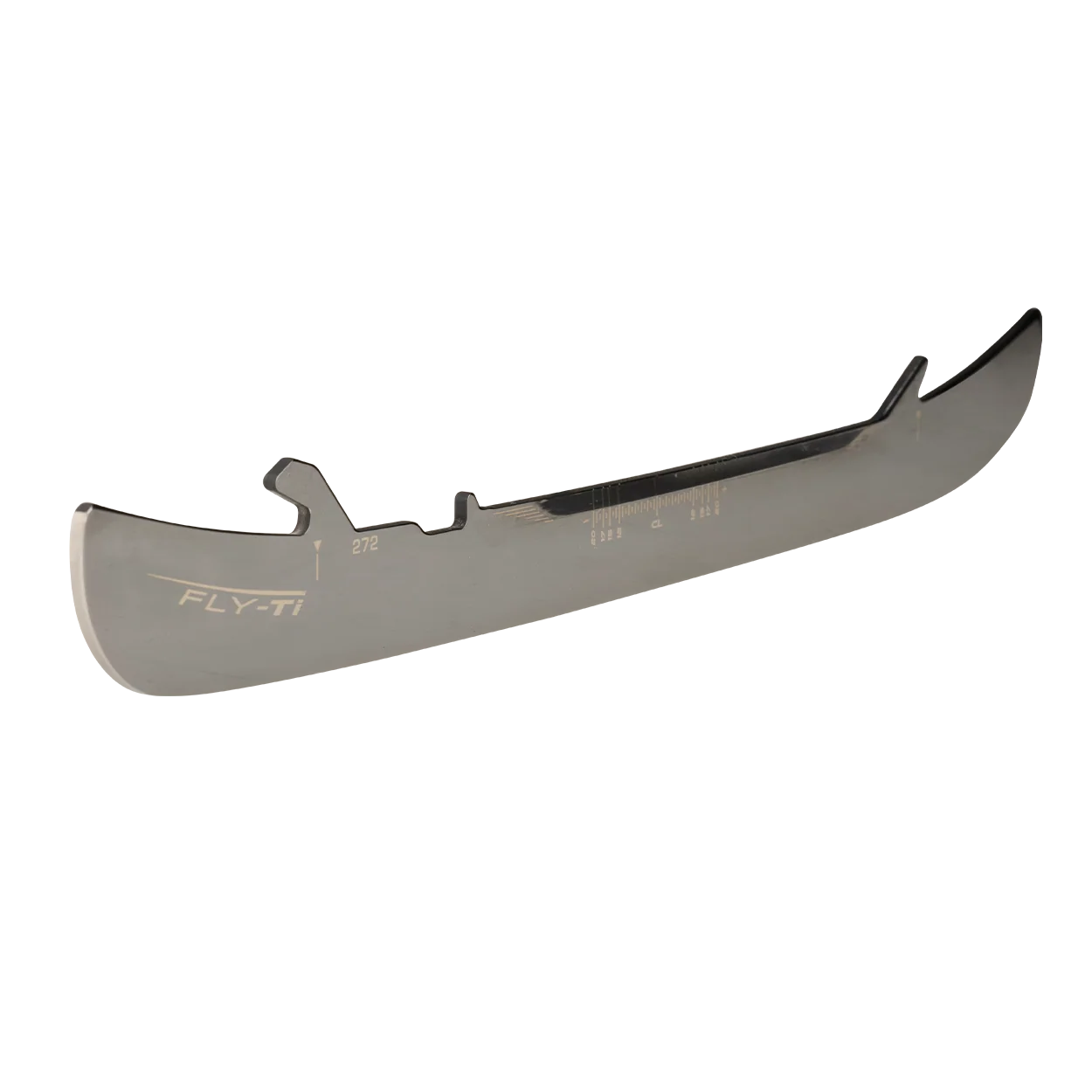
Genuine Bauer FLY-Ti metal hockey skate runner
THIS IS THE ACTUAL MATERIAL

PROFILED STEEL.
NOT A MAGIC UPGRADE.

Shaping metal removes metal. Record the current rocker before changing it, and don't sacrifice usable steel simply to buy a more complicated profile.

THE
MICROSCOPE
BELOW THE
RUNNER.

Look at the bottom of the steel instead of the side. Sharpening creates two working edges separated by a curved hollow. Altering the hollow doesn't change the runner's front-to-back rocker. Select a cut and watch the cross-section change.

FIGURE 004 / MAGNIFIED BLADE CROSS-SECTION 3.0 MM STEEL WIDTH INSIDE EDGEOUTSIDE EDGE BOTTOM OF BLADE / CONCAVE HOLLOW
ADJUST SHARPENING HOLLOW
1/2"

A relatively deep, grip-oriented hollow. The blade may feel more secure on edge, with a potential tradeoff in release and drag.

0.089 MMTHEORETICAL CENTER RECESS

Original, mathematically derived section. Assumes conventional circular sharpening and a 3.0 mm runner. The groove is magnified 7.5× vertically relative to the drawn width. Approximate actual groove depth is under two-tenths of a millimeter for the hollows shown. Sharpening technique, runner geometry, ice and skater mechanics affect real performance.

PROFILE ≠ HOLLOW.

A 10-foot rocker and a 1/2-inch sharpening hollow are both radii, but they describe different axes of the blade. One governs the front-to-back curve; the other governs its bottom edge geometry.

THE SKATE
CAN FEEL
FORWARD.
OR BACK.

Changing where an athlete feels centered above the runner can be as important as changing the curvature itself. A blade's profile, pivot position, holder and boot geometry all play a role. This teaching diagram isolates the concept without pretending to calculate actual body pressure.

FIGURE 005 / EFFECTIVE BALANCE REFERENCE HEELTOEMARKER IS CONCEPTUAL · NOT A MEASURED PIVOT
EXPLORE THE POSITION

THE NEUTRAL REFERENCE.

A balanced starting point makes other changes easier to assess. Neutral does not mean ideal for every athlete—it gives us a consistent reference for evaluating feel.

A profile can influence effective pitch without physically tipping the photographed boot. The marker represents a concept, not a diagnosis.

THE CREASEchangesEVERYTHING.

A goalie is not a defenseman with a different helmet. Forward strides are only one small part of a goaltender's skating demands. Shuffles, T-pushes, butterfly pushes, recoveries and post integration change the question entirely.
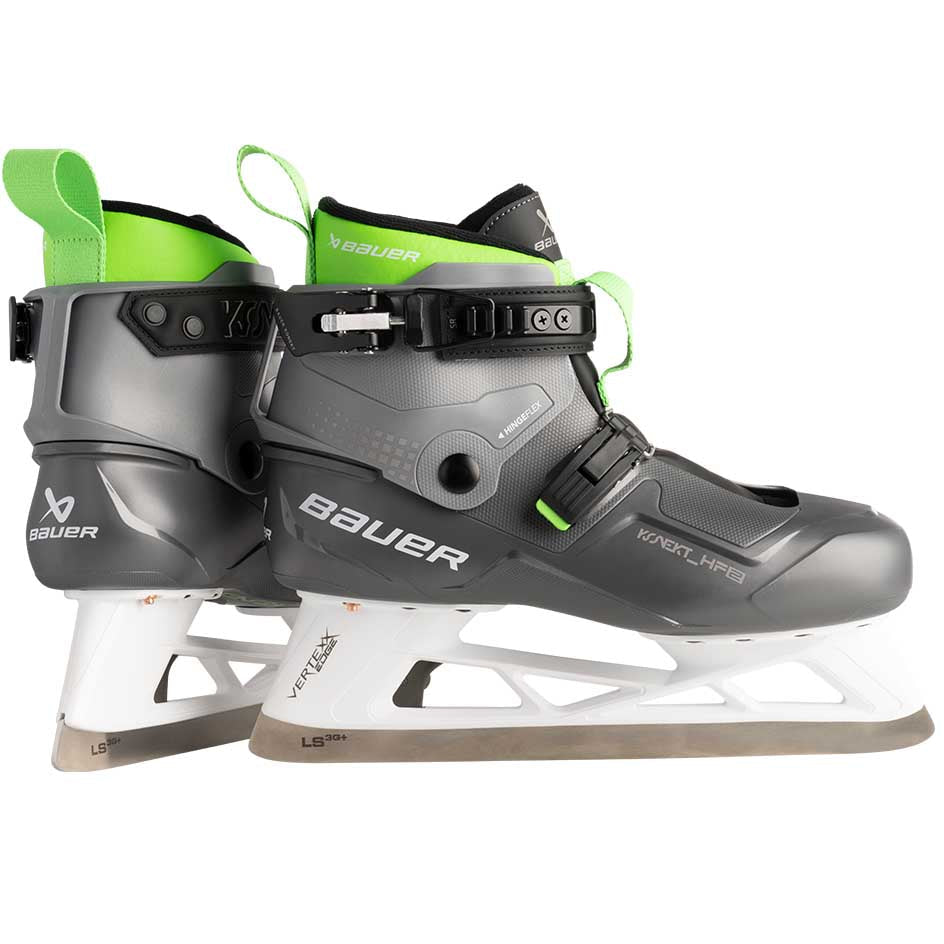
Genuine Bauer KONEKT HF2 goalie skates with hinged boot and VERTEXX EDGE holder
GOALIE REFERENCE BOOT / BAUER KONEKT HF2
NO PLAYER PROFILE PRESCRIPTIONS.STUDY THE MOVEMENT FIRST.

FOUR MOVES.
FOUR
QUESTIONS.

Select a movement. Rather than telling every goalie which profile to buy, the guide explains what the athlete needs to feel and what a technician should examine. Paths here show general travel direction, not prescribed technique.

FIGURE 006 / TOP-DOWN MOVEMENT STUDY
GOAL LINE DARK / STARTRED / END

Schematic travel study, not a precise foot-pressure map or technique prescription.

01 / SHORT LATERAL REPOSITIONING

SHUFFLE.

A controlled lateral adjustment should feel stable without unexpected edge catches or sluggish release. A technician must distinguish a hollow problem from an unsuitable rocker.

WATCH: EDGE RELEASE · BALANCE · LEFT–RIGHT SYMMETRY

CURVE.
FLAT.
CURVE.

A goalie SAM-type contour uses a central flat region bordered by different front and rear curvature. The intended measurements change between youth, junior and senior versions. Here the geometric concept is redrawn from mathematical definitions, not copied from anyone's graphic.

FIGURE 007 / SAM CONFIGURATIONS HEEL ARCCENTER FLATTOE ARC30 MMHEELTOE

Calculated circular arcs tangent to a central flat; not to scale with any commercial runner. Front and rear numerical values come from published manufacturer templates. This is not a machining template.

SWITCH HOLDER CATEGORY
8' / 30 MM / 22'
FRONT RADIUS / FLAT SECTION / REAR RADIUS

Different runner lengths require different distribution of geometry. The youth version has a relatively short 30 mm flat section.

TRADITIONAL.

A relatively stable, longer-radius rocker remains a valid starting point for many goaltenders.

FLAT SECTION.

Can change supported feel, but is not universally preferred during every recovery or shuffle.

CONTINUOUS ELLIPSE.

A progressive alternative. The right choice is determined by controlled on-ice comparison.

WHAT ABOUT
ELLIPSE?

A single-radius rocker is part of a circle. Elliptical geometry changes its curvature continuously. That is a different design approach, not a newer ranking of quality. Experiment with a mathematically defined ellipse to understand the concept.

FIGURE 008 / VARIABLE-CURVATURE GEOMETRY HEELTOE 10' CIRCULAR REFERENCE ELLIPTICAL EXAMPLE

Calculated geometry over 280 mm; vertical curvature deliberately exaggerated. Original mathematical illustration, not a proprietary commercial template.

CHANGE THE ELLIPSE

MORE CURVED.
LESS CURVED.

36 MM

An actual fitted contour also depends on runner length, pivot placement and proprietary geometry. The name “Ellipse” alone is not a prescription.

WHICH CHANGE
MAKES SENSE
FOR YOU?

There is no universal profile for a forward, a defenseman or a goalie. This quick assessment does not sell a profile. It teaches you what to investigate first.

A SMARTER NEXT STEP

KNOW BEFORE
YOU CHANGE.

If the athlete is skating comfortably, consistency and fundamental skill development are often more valuable than experimenting with additional radii.

START BY RECORDING YOUR CURRENT SKATE SETUP.

Educational decision aid, not a profile prescription, diagnostic test or substitute for an in-person technician assessment.

BEFORE THE
GRINDING
WHEEL TURNS.

A knowledgeable technician should be able to explain what is on the blade now, how the proposed contour differs, and how the result can be verified. These are the checks we want families to understand.

01MEASURE THE RUNNER.

Actual steel and holder length—not simply the number on the boot.

02RECORD THE STARTING GEOMETRY.

Existing rocker, pivot reference, pitch sensation and remaining usable steel.

03VERIFY EDGE LEVEL AND HOLLOW.

Sharpening defects can easily be mistaken for unsuitable profile geometry.

04CHANGE ONE VARIABLE.

A new profile and new hollow at the same time make comparisons unreliable.

05TEST REPEATABLE MOVEMENTS.

For players: transitions, turns and straight glides. For goalies: lateral movement, pushes and recovery.

06KEEP THE RECORD.

The best profile is useless if it cannot be reproduced on replacement steel.

THE LAST WORD
ON THE MOST
COMMON MYTHS.

01Does a Quad automatically make someone faster?

No. Four curvature zones do not guarantee a speed increase. An athlete's skating mechanics, technique, sharpening, fit and how the geometry suits them determine how the setup performs.

02Should a seven-year-old use a custom profile?

Not automatically. Correctly fitted skates, consistent sharpening and skating instruction come first. Small youth runners require appropriate geometry if profiling is ever considered.

03Do forwards and defensemen need different profiles?

Position influences movement priorities, but playing style and individual balance are more useful than a rigid positional rule.

04Is profiling the same thing as sharpening?

No. Profiling reshapes the blade from toe to heel. Sharpening creates or maintains the edges and bottom hollow across its width.

05Does a longer radius mean more speed?

Not necessarily. A longer radius can feel more supported and stable for some athletes, but actual speed results are not guaranteed.

06Why do different sizes need different templates?

The usable steel and holder lengths are different. A zone length designed for a senior runner may be unsuitable on a youth runner.

07Does a goalie need a different hollow?

Sometimes. Edge access for butterfly pushes, glide during shuffles, rink conditions and preference all matter. A deeper cut is not universally superior.

08Can sharpening change the profile over time?

Yes. Repeated grinding, especially inconsistent material removal at the toe and heel, can change the blade's original geometry.

09Can I restore an old profile if I dislike a change?

Sometimes, if the original was recorded and enough usable steel remains. Reprofiling requires further metal removal, so restoration is not always possible.

10What is the best skate profile?

The one that works predictably with the specific athlete and equipment. The answer should follow controlled testing—not a popular template name.

THE MATH IS
EXPLAINED.
THE SOURCES
ARE SHOWN.

Published numerical profile specifications and nomenclature are credited to the original manufacturer documentation. All educational diagrams on this page are independently drawn using mathematical definitions. No profiling-company promotional images have been used.

Bauer — Complete Skate Profiling Guide

Bauer — Profiling Technical FAQs

Manufacturer — Quad template measurements

Manufacturer — Goalie profile measurements

Sparx Hockey — Understanding the radius of hollow

Profile diagrams are educational, intentionally vertically magnified, and never suitable for grinding a blade. Manufacturer claims of performance should not be interpreted as universal test results.

HOCKEY DETOX CO / FIELD GUIDE NO. 002

KNOW YOUR
STEEL.then trustYOUR FEET.

Great equipment decisions start with understanding, not urgency. The best contour might be a carefully chosen custom profile. It might also be the one you already have.

RETURN TO THE GUIDE LIBRARY